What Does Intestate Mean in Miami, Florida?
Intestate means dying without a valid will. When a Florida resident dies intestate, they lose the ability to choose who receives their property. Instead, the distribution of their estate is determined entirely by Florida's intestacy statutes, found in Chapter 732 of the Florida Statutes. These laws establish a fixed order of inheritance based on family relationships. At the Law Offices of Albert Goodwin, PA, we help families across South Florida navigate the intestacy process and protect their rights as heirs.
How Florida Intestacy Laws Work
Florida's intestacy statutes create a default distribution plan that applies when someone dies without a will — or when a will fails to dispose of all of the decedent's property. The statutes identify which family members qualify as "heirs at law" and specify the share each heir receives. The probate court oversees the process, and a personal representative is appointed to administer the estate even though there is no will.
It is important to understand that intestacy laws only apply to probate assets — property that was owned solely by the decedent without a beneficiary designation or other automatic transfer mechanism. Assets held in a trust, jointly owned property with right of survivorship, life insurance proceeds with a named beneficiary, and retirement accounts with beneficiary designations all pass outside of intestacy rules.
The Surviving Spouse's Share Under Florida Intestacy
The surviving spouse occupies a central role in Florida intestacy law. The spouse's share depends on whether the decedent had descendants and, if so, whether those descendants are also descendants of the surviving spouse.
When the Decedent Has No Descendants
If the decedent dies without any surviving descendants (children, grandchildren, etc.), the surviving spouse inherits the entire intestate estate under Florida Statutes Section 732.102(1)(a).
When All Descendants Are Also Descendants of the Surviving Spouse
If the decedent's only descendants are also descendants of the surviving spouse (meaning the couple's children together and their issue), and the surviving spouse has no other descendants from a different relationship, the surviving spouse inherits the entire intestate estate under Florida Statutes Section 732.102(1)(b).
When All Descendants Are Also Descendants of the Surviving Spouse, but the Spouse Has Other Descendants
If the decedent's descendants are also descendants of the surviving spouse, but the surviving spouse has additional descendants from another relationship (such as children from a prior marriage), the surviving spouse receives one-half of the intestate estate under Florida Statutes Section 732.102(2).
When the Decedent Has Descendants Who Are Not Descendants of the Surviving Spouse
If the decedent has one or more descendants who are not also descendants of the surviving spouse — for example, children from a prior marriage — the surviving spouse receives one-half of the intestate estate under Florida Statutes Section 732.102(3). The decedent's descendants receive the other half.
Distribution to Descendants
When the decedent has descendants and there is no surviving spouse (or when the descendants receive a share of the estate alongside the surviving spouse), the descendants' share is distributed per stirpes under Florida Statutes Section 732.104.
What Per Stirpes Means
Per stirpes is a Latin term meaning "by the roots" or "by the branch." Under Florida's per stirpes distribution method, the estate is divided at the first generational level below the decedent that has at least one living member. Each living member at that level takes an equal share. If a member of that generation has predeceased the decedent but left descendants of their own, that deceased person's share passes down to their descendants in equal parts.
Example: John dies intestate with no surviving spouse. He had three children: Anna, Brian, and Carol. Anna is still living. Brian died before John but left two children (Brian Jr. and Beth). Carol also died before John and left one child (Cody). Under per stirpes distribution, Anna receives one-third, Brian Jr. and Beth each receive one-sixth (splitting Brian's one-third share), and Cody receives one-third (Carol's entire share, since Cody is her only descendant).
Distribution When There Is No Surviving Spouse or Descendants
If the decedent has no surviving spouse and no descendants, Florida's intestacy statutes provide a specific order of inheritance under Florida Statutes Section 732.103:
- Parents. The estate passes to the decedent's father and mother equally, or to the surviving parent if only one is living.
- Siblings and their descendants. If neither parent survives, the estate passes to the decedent's brothers and sisters and the descendants of deceased brothers and sisters, per stirpes.
- Grandparents and their descendants. If there are no surviving parents, siblings, or descendants of siblings, the estate is divided in half. One half goes to the decedent's paternal grandparents (or the survivor of them, or their descendants if neither survives) and the other half goes to the maternal grandparents (or the survivor of them, or their descendants if neither survives). If there are no surviving relatives on one side, the entire estate passes to the relatives on the other side.
If no heirs can be identified after an exhaustive search, the estate escheats to the State of Florida under Florida Statutes Section 732.107. Escheat is rare but does occur when a person dies with no identifiable relatives.
Special Considerations in Florida Intestacy
Homestead Property
Florida has unique constitutional protections for homestead property. The rules governing the descent of homestead are different from the rules governing other probate assets. Under Article X, Section 4 of the Florida Constitution, if the decedent is survived by a spouse and minor children, the homestead property cannot be devised by will at all — it passes to the surviving spouse as a life estate, with a vested remainder to the lineal descendants, unless the spouse elects to take an undivided one-half interest as a tenant in common with the descendants. If there are no minor children, the surviving spouse may receive the homestead outright depending on the circumstances. These homestead descent rules apply whether or not the decedent had a will.
Adopted Children
Under Florida Statutes Section 732.108, a legally adopted person is treated as a natural descendant of the adopting parent for all purposes of intestate succession. The adopted child inherits from and through the adoptive parent just as a biological child would. Conversely, adoption generally severs the legal relationship with the biological parents for inheritance purposes, with limited exceptions.
Half-Blood Relatives
Florida Statutes Section 732.105 addresses half-blood relatives (persons who share only one parent with the decedent). When the intestate estate passes to the decedent's collateral relatives (siblings, nieces, nephews, etc.) and all of the heirs are of the half blood, they inherit as if they were of the whole blood. When the inheritance involves a mix of whole-blood and half-blood relatives at the same level, each half-blood relative receives half the share of a whole-blood relative.
Posthumous Heirs
Under Florida Statutes Section 732.106, descendants of the decedent who are conceived before the decedent's death but born afterward (posthumous heirs) are treated as if they had been born during the decedent's lifetime for purposes of intestate succession.
The Intestate Probate Process
When someone dies intestate, the estate still goes through probate. An interested person — typically a surviving spouse, adult child, or other close family member — petitions the circuit court to open an estate and to be appointed as the personal representative. Florida Statutes Section 733.301 establishes a preference order for appointment: the surviving spouse has first priority, followed by the person selected by a majority in interest of the heirs.
The personal representative then performs the same duties as in a testate (with a will) estate: marshaling assets, notifying creditors, paying debts and taxes, and distributing the remaining property to the heirs according to the intestacy statutes.
Why Estate Planning Matters
Dying intestate means the State of Florida decides who inherits your property, in what proportions, and under what conditions. The statutory distribution may not reflect your actual wishes. Common problems caused by intestacy include:
- Unintended exclusions. Unmarried partners, stepchildren, close friends, and charities receive nothing under intestacy laws.
- Undesired proportions. You may want one child to receive more than another due to special needs, prior gifts, or other family circumstances, but intestacy distributes equally within each class of heirs.
- No control over management. Without a will or trust, you cannot name a guardian for minor children, create a trust for young beneficiaries, or specify how assets should be managed.
- Family conflict. Intestacy disputes — particularly over who should serve as personal representative or how assets should be valued — frequently lead to costly litigation.
- No probate avoidance. Without an estate plan, most assets will require probate, with its associated time, cost, and public exposure.
A comprehensive estate plan — including a will, a revocable living trust, proper beneficiary designations, and other planning tools — allows you to control exactly how your estate is handled and distributed.
Contact a Florida Intestacy Attorney
Whether a loved one has passed away without a will and you need to understand your rights as an heir, or you want to create an estate plan to ensure your family is protected, the Law Offices of Albert Goodwin, PA is here to help. We represent heirs, surviving spouses, and families throughout Miami-Dade County, Broward County, and Palm Beach County in all matters of intestate succession and estate planning. Call us at 786-522-1411 or email [email protected] to schedule a consultation at our Coral Gables office.
About the Author
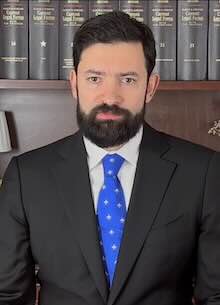
Albert Goodwin Esq. is a licensed Florida attorney with over 18 years of courtroom experience. His extensive knowledge and expertise make him well-qualified to write authoritative articles on a wide range of legal topics. He can be reached at 786-522-1411 or [email protected].