Marital Trusts & QTIP Trusts in Miami, Florida
By Albert Goodwin, Esq. — Florida Bar No. [attorney to insert]. Mr. Goodwin is the principal attorney at the Law Offices of Albert Goodwin, PA, concentrating in estate planning, trust administration, and probate for families in Miami-Dade and throughout South Florida. Reviewed for legal accuracy by the estate planning team at the Law Offices of Albert Goodwin, PA. Read Albert Goodwin's full bio.
Last updated: 2025. This page is our central resource on marital and QTIP trusts for Florida couples. For related topics, see our pages on the credit shelter trust, the Florida elective share, estate tax planning, and estate planning for blended families.
What Is a Marital Trust?
A marital trust is a trust created for a surviving spouse that is designed to qualify for the unlimited federal estate tax marital deduction under 26 U.S.C. § 2056. Assets that qualify for the marital deduction pass to the surviving spouse without federal estate tax at the first spouse's death. The most common form used by our Miami clients is the qualified terminable interest property (QTIP) trust, which lets the first spouse to die provide lifetime support for the surviving spouse while keeping control over who ultimately inherits the trust principal.
Florida is a common-law property state, not a community property state, which shapes how we structure marital trusts here. Because Florida has no state estate or inheritance tax, marital trust planning in Miami is driven primarily by three factors: federal estate tax deferral, protecting children from a prior marriage in a blended family, and the interaction of the trust with Florida's homestead and elective share rules. This page focuses on how the marital trust actually functions under Florida law and procedure, not just the federal statute.
The Marital Deduction and Why It Is a Deferral
The unlimited marital deduction under 26 U.S.C. § 2056 allows a spouse to transfer any amount to the surviving spouse at death, outright or in a qualifying trust, without federal estate tax. The policy is that the assets will be taxed in the survivor's estate at the second death instead. The marital deduction defers estate tax; it does not eliminate it. Anything remaining in the survivor's estate (or in the QTIP trust under 26 U.S.C. § 2044) is included in the survivor's taxable estate.
For this reason, marital trusts are typically paired with a credit shelter trust to use both spouses' federal exemptions. With the increased federal exemption scheduled to sunset after 2025, many Miami couples we advise are re-examining whether to rely on portability of the deceased spouse's unused exemption (DSUE) or on a traditional credit shelter/marital split. The tradeoff is discussed in the FAQ below.
Types of Marital Trusts
QTIP Trust (Qualified Terminable Interest Property)
Under 26 U.S.C. § 2056(b)(7), a trust qualifies as QTIP if (1) the surviving spouse is entitled to all trust income, payable at least annually, for life, and (2) no one can appoint trust property to anyone other than the surviving spouse during the spouse's lifetime. The personal representative must make an affirmative QTIP election on the federal estate tax return (Form 706). The election is due when Form 706 is due — nine months after death, extendable six months — a deadline our office calendars closely because a missed or defective election can forfeit the deduction. The defining benefit of the QTIP: the surviving spouse gets income for life, but the first spouse to die names the remainder beneficiaries, and the survivor cannot redirect them.
General Power of Appointment Trust
Authorized by 26 U.S.C. § 2056(b)(5), this trust qualifies for the marital deduction by giving the survivor all income for life plus a general power to appoint the principal to themselves, their estate, or their creditors. It gives the survivor total control — which is exactly why it is rarely appropriate for a Miami blended family, since the first spouse loses control of where assets ultimately go.
Estate Trust
An estate trust qualifies because all remaining assets are payable to the survivor's estate at death. It does not require annual income distribution, so it can hold non-income-producing assets. Because the assets pass through the survivor's own estate and will, it is generally unsuitable for blended-family goals.
QTIP Trusts, Blended Families, and Second Marriages in Miami
South Florida has a high concentration of remarriages and blended families. The recurring problem we see in Coral Gables and greater Miami-Dade is competing loyalty: the first spouse to die wants to support the surviving spouse but also wants their own children from a prior relationship to inherit. A QTIP trust solves this. The survivor receives all income for life (and, if drafted that way, principal for health, education, maintenance, and support), and whatever remains passes at the survivor's death to the children the first spouse named.
Leaving assets outright to a new spouse gives the deceased spouse's children no protection — the survivor is free to spend, gift, or leave everything to a new partner or their own children. The QTIP is the structural fix. For a broader discussion of these dynamics, see estate planning for blended families.
Anonymized Miami Scenario: The Coral Gables Second Marriage
Consider a common pattern: a retiree in his second marriage owns a Coral Gables home (his homestead), a brokerage account, and an IRA. He has two adult children from his first marriage; his wife has none. He wants his wife to live in the home and receive income for life, but wants his children to inherit what remains. A QTIP trust funded with the brokerage account provides lifetime income to the wife with the principal passing to his children at her death — while a marital agreement addresses the elective share and the homestead is handled separately (see below). This kind of coordination is the core of the planning, not the federal boilerplate.
Anonymized Miami Scenario: Non-Citizen Spouse
Miami's international population raises a specific issue: the ordinary marital deduction is not available for transfers to a non-U.S.-citizen spouse. Instead, a Qualified Domestic Trust (QDOT) under 26 U.S.C. § 2056A is generally required to defer estate tax. We frequently address this for clients whose spouse holds a green card but is not a citizen.
Florida Homestead and the Marital Trust
This is where Miami planning departs sharply from national content. Florida's homestead protections under Article X, Section 4 of the Florida Constitution restrict how a homestead can pass. If the decedent is survived by a spouse, the homestead cannot be freely devised: under F.S. § 732.401, the surviving spouse takes either a life estate with a vested remainder to the descendants, or — by election within six months under F.S. § 732.401(2) — an undivided one-half tenancy in common.
Because of these constitutional constraints, a Florida homestead often cannot simply be dropped into a QTIP or marital trust and treated like other assets. Attempting to fund a marital trust with homestead can trigger the constitutional devise restrictions and unintended results. In practice we frequently keep the homestead outside the marital trust and address it through instruments such as a Florida enhanced life estate (lady bird) deed, a spousal waiver of homestead rights, or a life-estate arrangement. See our homestead protection and inheriting homestead property pages for detail.
Florida Elective Share and Marital Trust Funding
Florida's elective share statute, F.S. § 732.201 through § 732.2155, entitles a surviving spouse to 30% of the decedent's "elective estate." This right exists regardless of what the will or trust says, so it must be accounted for in every marital trust plan.
The elective estate under F.S. § 732.2035 is far broader than the probate estate. It includes revocable trust assets, joint-with-survivorship accounts, pay-on-death accounts, certain life insurance, retirement benefits, and other lifetime transfers. Assets passing to or for the surviving spouse — including through a marital trust — count toward satisfying the elective share under F.S. § 732.2075 and the order of contribution rules.
A properly funded elective-share-qualifying QTIP can satisfy some or all of the 30% entitlement. But the funding must be precise. If the trust underfunds the elective share, the surviving spouse can elect and pursue additional amounts from other assets under the statutory order of contribution — potentially disrupting the very children's inheritance the QTIP was meant to protect. Many of our Miami second-marriage clients pair the QTIP with a prenuptial or postnuptial agreement waiving the elective share under F.S. § 732.702, which requires a voluntary, written waiver and, for post-marital agreements, fair disclosure. For the full framework, see our elective share page.
Funding a Marital Trust in Florida — The Mechanics
Drafting the trust is only half the job; funding it correctly is what makes it work. In Florida practice, funding a marital trust typically involves:
- Retitling brokerage and bank accounts into the name of the trust after the first death, or via a pour-over structure.
- Recording deeds for Florida real property (other than protected homestead) in Miami-Dade County, with attention to documentary stamp tax exemptions on transfers to a trust for no consideration.
- Reviewing beneficiary designations on IRAs, life insurance, and annuities, since retirement accounts payable to a QTIP raise special income-tax and SECURE Act distribution issues.
- Applying a properly drafted funding formula to allocate assets between the marital and credit shelter shares.
- Coordinating with the personal representative to make and preserve the QTIP election on Form 706.
Portability Filing Practice in Florida
Since Florida imposes no separate estate tax, portability is a federal matter — but it still requires an affirmative filing. To carry the deceased spouse's unused exemption (DSUE) to the survivor, the estate must timely file a Form 706 electing portability, even if no tax is due and no return would otherwise be required. Under Rev. Proc. 2022-32, eligible estates that are not otherwise required to file may make a late portability election up to five years after death. We routinely advise Miami surviving spouses and personal representatives on preserving DSUE, because failing to file can permanently waste the first spouse's exemption.
Marital Trust Administration Under the Florida Trust Code
Once the first spouse dies, the marital trust becomes irrevocable and is governed by the Florida Trust Code, F.S. Chapter 736. The trustee owes fiduciary duties under F.S. § 736.0802 (loyalty) and F.S. § 736.0803 (impartiality).
Duty of Impartiality
The hardest part of QTIP administration is impartiality under F.S. § 736.0803. The trustee must balance the income beneficiary (the surviving spouse) against the remainder beneficiaries (often the children). Investment strategy must serve both current income and principal preservation. In blended families these interests conflict, and disputes are common — see our resource on breach of fiduciary duty.
Income and Principal Allocation
The Florida Uniform Principal and Income Act, F.S. Chapter 738, dictates how receipts and expenses split between income and principal. Because the QTIP spouse receives all income, allocation directly affects distributions. Capital gains generally go to principal. The trustee's power to adjust (F.S. § 738.104) and to convert to a unitrust (F.S. § 738.1041) can be essential tools for fairness.
Tax Treatment
A QTIP trust files IRS Form 1041 as a separate taxable entity; distributed income is deductible by the trust and reported by the surviving spouse, usually avoiding the trust's compressed brackets. At the survivor's death, the QTIP assets are included in the survivor's gross estate under 26 U.S.C. § 2044 and receive a stepped-up basis under 26 U.S.C. § 1014. The trust instrument should specify how any resulting estate tax is apportioned.
Coordinating the Marital Trust with a Credit Shelter Trust
In a classic AB plan, at the first death an amount equal to the available exemption funds the credit shelter trust (B) and the balance funds the marital trust (A). This uses both exemptions while giving the survivor benefits from both. A formula clause governs the split and must account for the federal exemption, the GST exemption, and specific-asset allocations. Where dynasty goals exist, the credit shelter share may be structured as a generation-skipping trust. For high-net-worth planning, this connects to estate tax planning and, where control-preservation matters, irrevocable trusts.
Frequently Asked Questions
When must the QTIP election be made, and can it be fixed later?
The QTIP election is made on the estate's Form 706, due nine months after death (with a six-month extension available). It is generally irrevocable once made. If a return is not timely filed, relief may be limited, which is why the election deadline should be calendared immediately after the first spouse's death.
Portability or a credit shelter trust — which is better after the 2025 exemption changes?
Portability is simpler and preserves basis step-up at both deaths, but the DSUE is not indexed for inflation and is lost if the survivor remarries and that spouse dies first. A credit shelter trust shields post-death appreciation from estate tax and provides creditor and remarriage protection, but assets in it do not get a second step-up. With the federal exemption scheduled to drop after 2025, many Miami couples are keeping flexible "disclaimer" or QTIP-electable structures so the decision can be made after the first death. This is a fact-specific analysis for an attorney and tax advisor.
What happens if the marital trust does not satisfy the Florida elective share?
Assets passing to or for the surviving spouse count toward the 30% elective share under F.S. § 732.2075. If the trust and other spousal transfers fall short, the surviving spouse may elect and collect the deficiency from other estate assets under the statutory order of contribution, which can reduce what the deceased spouse's children receive. Proper funding and, often, a spousal waiver under F.S. § 732.702 prevent this outcome.
Can a Florida homestead be placed in a marital or QTIP trust?
Usually not without careful planning. Homestead devise is restricted by Article X, Section 4 of the Florida Constitution and F.S. § 732.401 when a spouse survives. Homestead is generally addressed outside the marital trust through a life estate, a lady bird deed, or a valid spousal waiver.
Does a non-citizen surviving spouse change the plan?
Yes. The ordinary marital deduction is not available for transfers to a non-citizen spouse; a Qualified Domestic Trust (QDOT) under 26 U.S.C. § 2056A is generally needed to defer estate tax. This is common in Miami's international community.
Speak With a Miami Marital Trust Attorney
Whether you need a QTIP trust to protect children from a prior marriage, an AB plan to preserve both spouses' exemptions, guidance on how Florida homestead and elective share interact with your trust, or help administering a marital trust after a spouse's death, the Law Offices of Albert Goodwin, PA can help.
We serve individuals and families throughout Miami-Dade, Broward, and Palm Beach Counties. Our office is at 121 Alhambra Plaza #1000, Coral Gables, FL 33134. To schedule a consultation, call 786-522-1411 or email [email protected].
This page is provided for general informational purposes and does not constitute legal or tax advice. Estate and tax planning depends on your specific facts; consult a qualified Florida attorney before acting.
About the Author
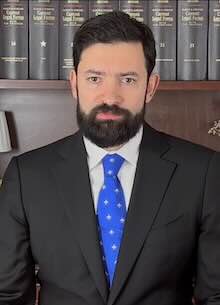
Albert Goodwin Esq. is a licensed Florida attorney with over 18 years of courtroom experience. His extensive knowledge and expertise make him well-qualified to write authoritative articles on a wide range of legal topics. He can be reached at 786-522-1411 or [email protected].